
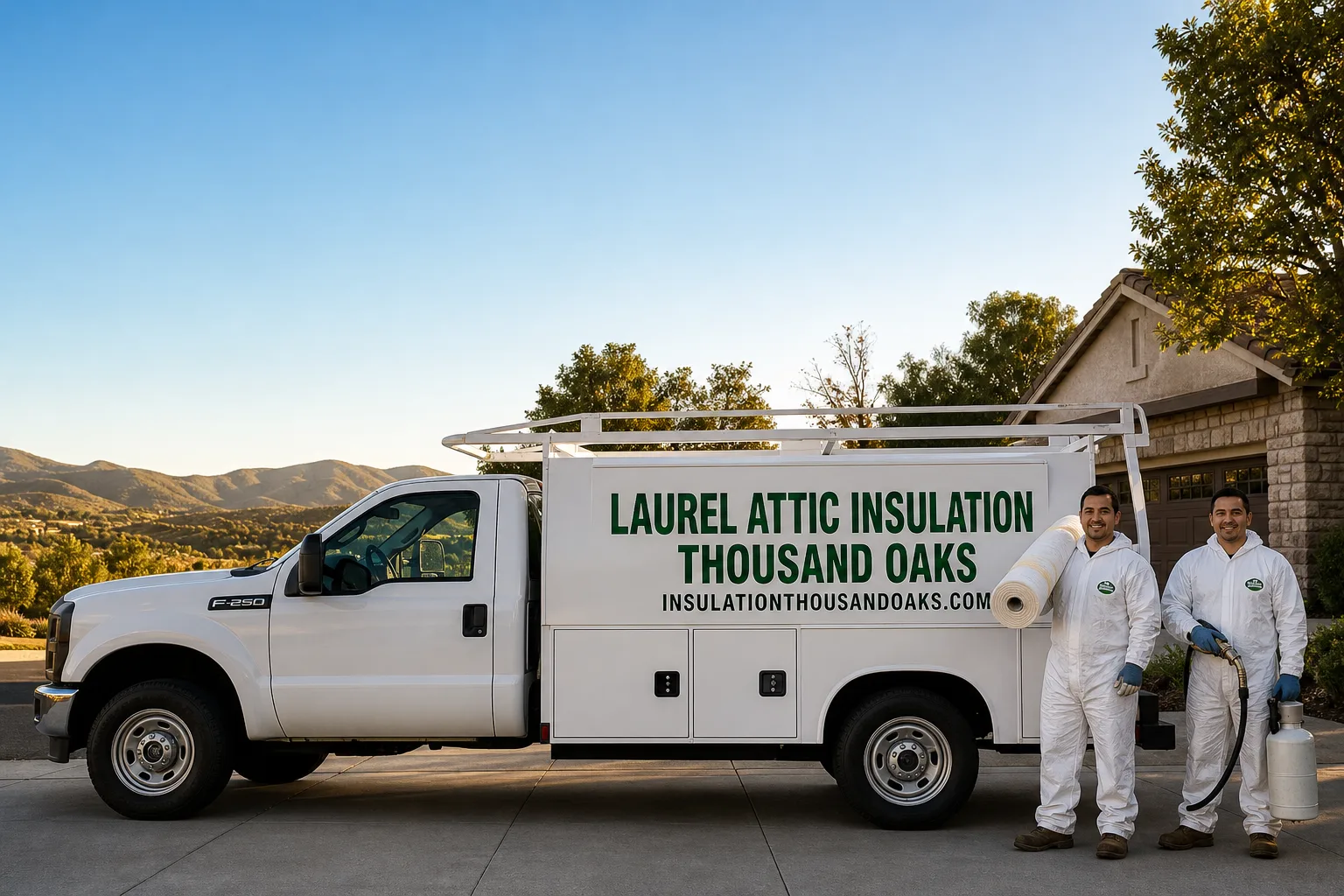
How Much Does Spray Foam Insulation Cost in Thousand Oaks?
Spray foam insulation in Thousand Oaks typically costs between $1.25 and $3.40 per board foot for open-cell foam, and $1.95 to $4.80 per board foot for closed-cell. For a standard 1,500-square-foot attic, most homeowners pay between $3,400 and $9,600 total, depending on foam type, R-value target, and the condition of the existing attic. We’ve been installing our Spray Foam Insulation services across Thousand Oaks since 2003, and those numbers reflect what we’re quoting on real jobs in neighborhoods like Newbury Park, Lynn Ranch, and Wildwood this year.
Key takeaways:
- Open-cell spray foam in Thousand Oaks: $1.25 – $3.40 per board foot
- Closed-cell spray foam in Thousand Oaks: $1.95 – $4.80 per board foot
- Typical whole-attic job: $3,400 – $9,600
- Most Thousand Oaks homes need R-38 to R-49 in the attic (Title 24 standard)
- Closed-cell costs more upfront but pays back faster in Ventura County’s climate
- Free estimates from Laurel Attic Insulation include a written price before any work starts
If you want a real number for your specific attic, call (820) 200-1971. We’ll give you a written quote based on your square footage, existing insulation, and target R-value. No door-step surprises.
Spray Foam Insulation Cost Breakdown (2026)
Here’s what spray foam insulation actually costs in Thousand Oaks this year, broken down by material, application area, and project type. These are the numbers we quote on a daily basis for homes in the Conejo Valley, from older ranch-style houses near Thousand Oaks Boulevard to newer builds up in Dos Vientos.
2026 Thousand Oaks Spray Foam Pricing Table
| Project Type | Foam Type | Typical Cost Range |
|---|---|---|
| Attic (1,200 – 1,800 sq ft, 2-inch lift) | Open-cell | $2,900 – $5,200 |
| Attic (1,200 – 1,800 sq ft, 3-inch lift) | Closed-cell | $4,700 – $8,900 |
| Attic (2,000 – 3,000 sq ft) | Open-cell | $5,000 – $8,600 |
| Attic (2,000 – 3,000 sq ft) | Closed-cell | $8,200 – $14,400 |
| Crawl space (800 – 1,200 sq ft) | Closed-cell | $2,800 – $5,000 |
| Rim joist / band joist only | Closed-cell | $1,100 – $2,200 |
| Wall cavity (existing home, stud bays exposed) | Open-cell | $1,800 – $3,400 per 500 sq ft |
| Metal building or pole barn (per sq ft of roof deck) | Closed-cell | $2.50 – $4.25 per sq ft |
A board foot is insulation covering one square foot at one inch thick. That’s the unit most spray foam contractors quote by, so if someone gives you a per-square-foot number instead, multiply by the inches of foam you’re getting. For example, 2 board feet is the same as 1 square foot at 2 inches thick.
What Drives the Price Up
- Closed-cell vs. open-cell. Closed-cell foam runs roughly 50 – 60% more per board foot because it’s denser, has a higher R-value per inch, and acts as a vapor barrier.
- Target R-value. Thousand Oaks sits in California climate zone 6 (or 3C depending on the exact microclimate, with areas like Dos Vientos sitting a bit cooler than the valley floor). Most attics need R-38 minimum, which means about 5 – 6 inches of open-cell or 3 – 3.5 inches of closed-cell. Thicker lifts mean more board feet.
- Existing insulation removal. If you have old fiberglass batts, blown-in cellulose, or rodent-damaged material, it has to come out first. Removal runs $1.10 – $2.30 per square foot in Thousand Oaks and typically adds $1,200 – $3,500 to the total job.
- Access and prep. Attics with limited headroom, vaulted ceilings, or a lot of recessed can lights take longer to prep. Each fixture needs to be masked before spraying. A standard Thousand Oaks tract home has 8 – 14 can lights; that’s real labor time.
- Air sealing work. The best results come when the attic is air-sealed before foam is applied: penetrations around plumbing stacks, electrical runs, and top plates get sealed first. We include this in every quote, but not every contractor does. Ask.
What Drives the Price Down
- Smaller square footage. Obviously.
- Open-cell foam for attic-only jobs. If you’re not insulating crawl spaces or walls, open-cell gets you to R-38 for a lower material cost. We use materials from brands like Icynene and Demilec for open-cell applications, matched to the job rather than whatever is on the truck.
- Winter scheduling. Spring and early summer are peak season for spray foam in Thousand Oaks because homeowners start thinking about AC bills. Late fall and winter are slower, and some contractors offer off-peak pricing. We do not run gimmicky discounts, but our fall schedule is usually more flexible, which can mean faster start dates.
For context, you can compare this with our broader guide to spray foam insulation in Thousand Oaks, which covers how the material performs in our specific climate.
What Affects Spray Foam Insulation Pricing in Thousand Oaks
Every city has its own cost profile, and Thousand Oaks is no different. Here’s what actually moves the needle here, based on the houses we see every week.
- Microclimate variation across the Conejo Valley. Homes up in Dos Vientos and the hills around Lang Ranch run 5 – 10 degrees cooler than the valley floor near Janss Marketplace. That changes the R-value conversation. Homes at higher elevation with more wind exposure often benefit from closed-cell foam on the roof deck, which adds cost upfront but cuts heating demand substantially from October through March.
- Age and construction style of the home. Thousand Oaks has a huge stock of 1960s and 1970s ranch homes. Many of those attics have old, compressed fiberglass with R-values in the single digits, and a lot of them have vermiculite or rodent issues. Prep time on those jobs is higher than on the 1990s and 2000s stucco builds you see in Newbury Park, where attics are more uniform.
- Title 24 requirements. Ventura County enforces California’s Title 24 energy code. When you add spray foam insulation, certain roof assemblies may require a thermal barrier, and attic knee walls in bonus rooms need specific R-values. Complying with these codes adds material and inspection steps that affect total project cost. We factor all of it into our written quote so there are no mid-job surprises.
- Attic configuration. A single-story ranch with a truss attic is a straightforward spray. A two-story home with a vaulted ceiling over the living room, a bonus room over the garage, and a scuttle hole access in a hallway closet is much more involved. Board foot pricing only tells part of the story; labor time is the other half.
- Existing ductwork location. In many Thousand Oaks homes, the HVAC ducts run through the attic. That means the attic is effectively part of the conditioned space envelope, which changes insulation strategy. Sealing the attic and bringing the ducts inside the thermal boundary usually means insulating the roof deck rather than the attic floor. That’s a bigger material buy, but it cuts energy loss dramatically in summer when attic temps hit 130°F.
- Rodent and pest activity. Thousand Oaks has a serious rat problem in the fall and winter, especially in neighborhoods near open space like Wildwood and the hills around California Lutheran University. If your attic has had rodent activity, removal and sanitization happen before any foam goes in. That’s a necessary cost that doesn’t show up in generic online pricing guides.
Open-Cell vs. Closed-Cell: Cost and Performance in Thousand Oaks
This is the question we answer most often. The two foams look the same coming out of the gun, but the economics are different enough that it’s worth being specific.
Open-Cell Spray Foam
Open-cell foam costs $1.25 – $3.40 per board foot in Thousand Oaks. It has an R-value of about 3.7 – 3.9 per inch, so getting to R-38 means a 6 – 7 inch lift. It’s lighter, expands more, and is excellent for sound dampening. The downside: open-cell is air-permeable at the material level and does not act as a vapor barrier. In a dry climate like ours, that’s usually fine for attic floor applications, but it’s not the right choice for a crawl space or roof deck where moisture might be a consideration.
Closed-Cell Spray Foam
Closed-cell foam costs $1.95 – $4.80 per board foot. Its R-value is about 6.8 – 7.0 per inch, so a 3-inch lift gets you past R-21, which is why we use it for roof decks, crawl spaces, and wall cavities. It’s dense, rigid, and acts as both an air and vapor barrier. In Thousand Oaks, where we get maybe 16 inches of rain a year and the bigger issue is heat, closed-cell on the roof deck is the single biggest upgrade you can make to a poorly insulated attic. It’s more expensive, but for homes with attic ductwork, it’s usually the correct choice.
Which one to choose? If your ducts are in the attic and you run AC from June through October, spend the extra money on closed-cell for the roof deck or go with open-cell if your ducts are in the floor and the attic is mostly unused space. If you’re not sure, call us at (820) 200-1971. We’ll look at your specific layout and tell you the truth.
Spray Foam vs. Other Insulation Types: Thousand Oaks Cost Comparison
Spray foam is not the only option, and it’s not always the right one. Here’s how it stacks up against the alternatives we install, using real Thousand Oaks pricing.
| Insulation Type | R-Value per Inch | Typical Attic Cost (1,500 sq ft) | Best For |
|---|---|---|---|
| Open-cell spray foam | 3.7 – 3.9 | $3,400 – $6,800 | Attic floor, sound control |
| Closed-cell spray foam | 6.8 – 7.0 | $5,900 – $11,500 | Roof deck, crawl space, walls |
| Blown-in fiberglass (R-38) | 2.2 – 2.9 | $1,400 – $2,800 | Budget attic floor insulation |
| Blown-in cellulose (R-38) | 3.2 – 3.8 | $1,800 – $3,200 | Retrofit attics, good air-sealing |
| Fiberglass batts (R-38) | 3.1 – 3.4 | $1,600 – $3,000 | New construction, uniform joist bays |
| Rockwool batts (R-38) | 3.7 – 4.2 | $2,400 – $4,200 | Fire resistance, sound control |
Spray foam costs more than blown-in fiberglass or cellulose. That’s not arguable. What matters is whether the performance difference justifies the price difference for your specific house. In an attic with ductwork running through it, spray foam on the roof deck can cut summer attic temperatures from 135°F down to 85°F or lower. That’s not an incremental improvement; it’s a different house.
We install all of these materials. We’re not a one-material shop. If blown-in cellulose at R-38 is the right call for your ranch home north of the 101, that’s what we’ll recommend. We source from Owens Corning, Johns Manville, Knauf, Rockwool, CertainTeed, Icynene, Demilec, and GreenFiber, so the material recommendation follows the house, not the inventory.
How to Save on Spray Foam Insulation in Thousand Oaks
Spray foam is a premium product, but there are legitimate ways to keep the cost manageable without cutting corners.
- Get the scope right. You don’t always need to spray foam every surface of your attic. Sometimes the right fix is closed-cell foam on the roofline only and blown-in fiberglass on the attic floor below. We quote the full build and the scaled-down build, side by side, so you can decide with real numbers.
- Do the air sealing now, not later. The single biggest mistake homeowners make is skipping air sealing before insulating. Air sealing is your cheapest dollar-per-BTU-saved. If you’re going to insulate, seal first. Adding foam to an unsealed attic traps heat and moisture where you don’t want it.
- Bundle removal with the retrofit. If your attic has old insulation that needs removing, doing it in the same visit as the spray foam install saves a separate mobilization fee. Most Thousand Oaks insulation companies charge $150 – $400 per truck visit just for showing up. One visit is cheaper than two.
- Check for utility rebates. SoCalGas and Southern California Edison periodically offer insulation rebates through the Energy Upgrade California program. As of 2026, some Thousand Oaks homeowners are eligible for $0.30 – $0.50 per square foot in rebates for attic insulation upgrades that meet Title 24 standards. We’ll tell you what’s available for your address, but we don’t control the program.
- Schedule smart. If you’re flexible on timing, the shoulder seasons (October – November and February – March) are when our calendar is least packed. That often means faster start dates, and occasionally means we can fit a smaller job into a gap between larger ones.
- Don’t pay for R-value you don’t need. R-60 in a Thousand Oaks attic is overkill unless you’re in a custom build up in the hills with a massive HVAC load. R-38 to R-49 is the sweet spot for most of the Conejo Valley. Going above R-49 costs real money and returns pennies.
We offer free estimates with a written price before any work starts. Call (820) 200-1971 and we’ll give you exact numbers for your attic, not a range from a website.
FAQs – Spray Foam Insulation Cost
How much does spray foam insulation cost per square foot in Thousand Oaks?
Spray foam insulation in Thousand Oaks costs $1.25 to $3.40 per square foot per inch of thickness (board foot) for open-cell, and $1.95 to $4.80 per board foot for closed-cell. For a typical 1,500-square-foot attic getting 5 – 6 inches of open-cell foam, that works out to $3,400 to $6,800 total. Our quotes always show the per-board-foot cost and the total in writing before any work starts. Call (820) 200-1971 for a free estimate specific to your home.
Is spray foam insulation worth the extra cost compared to fiberglass?
For most Thousand Oaks homes with attic ductwork, yes. Spray foam on the roof deck can reduce attic temperatures by 40 – 50°F in summer, which translates to measurable AC savings from June through October. Fiberglass batts or blown-in insulation cost less upfront ($1,400 – $3,000 vs. $3,400 – $11,500), but they don’t air-seal or address the radiant heat problem that drives Thousand Oaks summer energy bills. Spray foam pays back fastest in homes where the attic is full of ducts.
How much does it cost to remove old insulation and install spray foam in Thousand Oaks?
Insulation removal runs $1.10 – $2.30 per square foot, so for a 1,500-square-foot attic, expect to pay $1,650 – $3,450 for removal. Adding spray foam on top of that brings the total to $5,000 – $10,000 for a complete removal-and-retrofit job. Rodent remediation, if needed, adds $500 – $2,000 depending on the extent of the problem. We include removal costs in every quote we write for Thousand Oaks homeowners.
Can you install spray foam insulation the same day in Thousand Oaks?
Small rim-joist and crawl-space jobs can often be scheduled and completed in one day. Full attic spray foam jobs typically take one to two days on site, but scheduling lead time varies by season. We give you a live, trackable arrival time when you book, so you’re never waiting on a four-hour window. Call (820) 200-1971 and we’ll tell you what our calendar looks like this week.
How long does spray foam insulation last, and is it cheaper to replace than fiberglass?
Spray foam insulation lasts 30 – 50 years when properly installed, which means most Thousand Oaks homeowners will never need to replace it. Fiberglass batts typically lose R-value after 15 – 20 years due to settling, moisture, and rodent damage. The upfront cost of spray foam is higher, but on a per-year basis it’s comparable or cheaper than replacing fiberglass every 15 years. Every job we install includes our 365-Day Done Right Promise in writing.
Why Thousand Oaks Homeowners Choose Laurel Attic Insulation
We’re not the only insulation contractor in the Conejo Valley, but we’re the only one that gives you written pricing before any work starts, live tracking on the day of the job, and before-and-after photos of every square foot we insulate. That’s the Relay Visibility Guarantee, and it’s included on every job. Founded in 2003, Laurel Attic Insulation is independently owned and operated within the Relay Home Co. family, and it’s led by Chase Whitaker, who has spent two decades in Thousand Oaks attics learning what works and what doesn’t in this specific climate.
The name Laurel is intentional. Laurel stays green all year, and so should your home’s comfort. That’s the idea behind the name.
Our technicians are background-checked and uniformed. They arrive at a live, trackable time, not a vague four-hour window. They use professional-grade materials from Owens Corning, Icynene, Demilec, Rockwool, and other trusted manufacturers, chosen for your house and not for our inventory. And every job comes with three non-negotiable guarantees:
- A written price before any work starts. No door-step surprises, no “we found something else” mid-job unless you approve it in writing.
- A written guarantee on every job. The 365-Day Done Right Promise: if it’s not right, we make it right, backed in writing.
- A free second visit if the work fails. No charge, no argument.
If you call us at 2 a.m. because you’re thinking about your energy bill, a live person answers. No voicemail, no callback queue, no phone tag. That’s been true since day one, and it’s not changing.
Get a Real Thousand Oaks Spray Foam Quote Today
Stop reading pricing guides and get a number for your actual house. We’ll come out, measure your attic, look at your ductwork, and tell you exactly what spray foam insulation will cost, in writing, before any work begins. Free estimates, no obligation, and no pressure.
Call (820) 200-1971 or book online. Most Thousand Oaks homeowners get a written estimate within 48 hours of calling. And yes, you’ll get before-and-after photos of the job. That’s the Relay Standard, and it’s how we do every project.
Written by Chase Whitaker, Owner at Laurel Attic Insulation Thousand Oaks, serving Thousand Oaks, Newbury Park, Westlake Village, and the Conejo Valley since 2003.
Pricing reflects the Thousand Oaks market as of 2026. Laurel Attic Insulation Thousand Oaks offers free estimates – call (820) 200-1971.
What Our Customers Say
"Utility bill dropped the next month. Our summer electric bill was lower by a visible amount."
- Gary J."Air sealing around the hatch and can lights. Tidy and quick."
- Mack R."Removed old insulation and replaced it. Upstairs is cooler now."
- Ella F.