
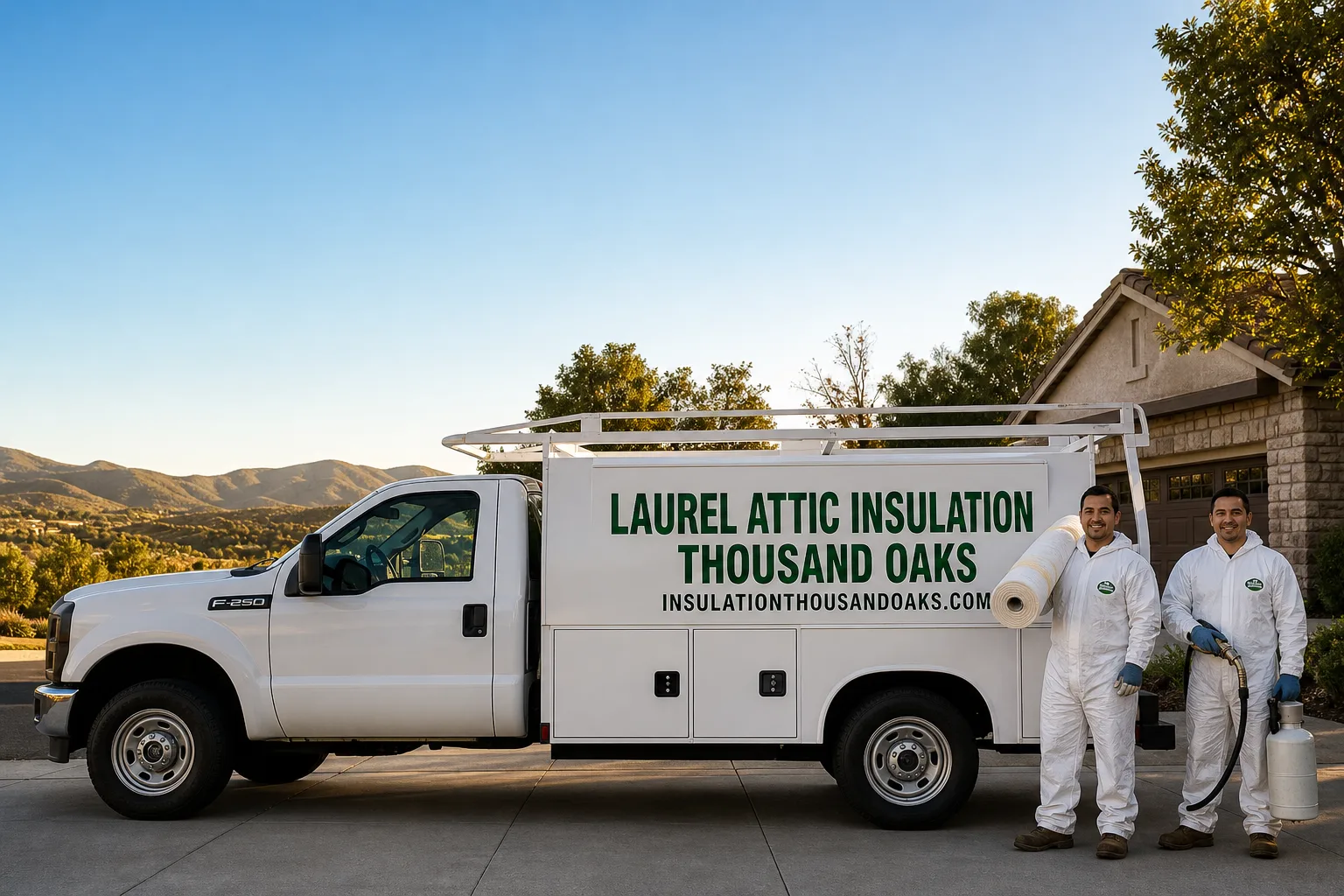
Fast, Reliable Attic Insulation Across West Hills
Attic insulation replacement in West Hills typically runs $1,400 – $3,200 for a full removal and re-insulation of a standard 1,500 – 2,000 square foot ranch home, and most jobs are completed in a single day. That’s the number we quote most often for the 1960s-1980s single-story homes that dominate this side of the valley. If your attic still has the original fiberglass batts, it’s almost certainly under-insulated, and the Santa Ana winds that sweep through West Hills make it worse than you’d think. Call Laurel Attic Insulation Thousand Oaks at (820) 200-1971 for a written quote before any work starts.
Our crews serve West Hills directly, and our dispatch is coordinated from the Los Angeles office. When you book, you get a live arrival time, not a vague window. We know the single-story ranch layouts along Valley Circle Boulevard, the homes tucked near Knapp Ranch, and the cul-de-sacs off Platt Avenue. That local familiarity matters when you’re dealing with an attic that hasn’t been touched since the Carter administration.
Why Laurel Attic Insulation Thousand Oaks Is West Hills’s Preferred Attic Insulation Company
West Hills homeowners keep calling us back because we show up when we say we will, and we put every price in writing before the first tool comes out. That’s the Relay Visibility Guarantee: a written quote, live technician tracking, and before-and-after photos on every single job. No contractor in this area offers that level of transparency, and it’s why our West Hills customers tell us the experience feels less like a home service call and more like tracking a rideshare.
Chase Whitaker leads our team, and he’s built a crew that understands the specific failure modes in West Hills attics. Original batts compressed to R-11. Blown-in fiberglass pushed into eaves by Santa Ana pressure. Attic access hatches that leak conditioned air. Chase and the crew have seen all of it and fixed all of it. We’re not guessing at what your attic needs; we’ve been in hundreds just like yours across this part of the San Fernando Valley.
We answer the phone 24/7 with a live person. You won’t get a voicemail tree or a callback queue. Call (820) 200-1971 at midnight or at noon, and a real human picks up. That’s the standard we hold across the Relay Home Co. family, and it’s a big reason West Hills homeowners who’ve been burned by no-show contractors stick with us.
How Santa Ana Winds Damage Attic Insulation in West Hills
West Hills sits directly in the Santa Ana wind corridor entering the western San Fernando Valley. That’s not trivia; it changes everything about how attic insulation performs here. Seasonal Santa Ana events create strong pressure differences between the attic and the living space. Air gets pulled through every gap in the ceiling plane: can lights, attic hatches, top plates, plumbing penetrations. And when that happens in a West Hills attic with loose-fill insulation, the fill doesn’t stay put. It gets pushed toward the eaves and corners, leaving the center of the ceiling exposed. Our Attic Insulation team sees this pattern constantly in homes along Valley Circle Boulevard and throughout streets near Knapp Ranch. The telltale sign is a bedroom that’s impossible to cool in summer, even with the AC running. The insulation isn’t where you think it is.
Here’s the practical impact: loose-fill fiberglass or cellulose that’s been blown into corners loses its effective R-value by half or more. R-value, for the uninitiated, is the number that measures how well insulation slows heat from moving through your ceiling. R-38 fiberglass that’s been wind-washed into a pile against the eave is doing almost nothing for the middle of your ceiling. Homeowners east of Topanga Canyon don’t deal with this the same way. West Hills does. If you want to understand attic insulation here, you have to understand wind-wash.
What We Found on a Ranch Home Along Valley Circle Boulevard
We’ll give you a real example. On a ranch-style home along Valley Circle Boulevard, we found blown-in fiberglass piled into the eaves after a Santa Ana event, leaving the ceiling plane exposed and the homeowner’s upstairs bedrooms running eight degrees hotter than the rest of the house. Our crew removed the displaced material, air-sealed the top plates and can lights, then re-insulated with Owens Corning AttiCat to the full R-38 depth with wind-wash baffles at the eaves. The homeowner called us back two weeks later to say the bedrooms finally held temperature for the first time in years. That’s the exact fix West Hills attics need: sealing first, then insulation that stays where you put it.
Attic Mold Removal in West Hills
Attic Mold Removal in West Hills is a service we handle more often than most people expect. The same wind-driven pressure differences that displace insulation also pull moist indoor air into the attic during winter and push dry, dusty attic air into the house during Santa Ana events. In some West Hills homes, particularly those with older can lights or unsealed attic hatches, that pressure cycling creates condensation on the underside of the roof sheathing. Where there’s consistent condensation, mold follows. We remove moldy insulation, treat affected framing, seal the air leaks that caused the moisture problem in the first place, and re-insulate cleanly. That last part matters. Pulling out moldy insulation without sealing the leaks means the mold comes back next winter.
Mold Source Assessment
The first step in any attic mold removal in West Hills is finding where moisture is entering. In these 1960s-1980s ranch homes, the usual suspects are bathroom exhaust fans venting into the attic, recessed lighting fixtures with leaky housings, and plumbing vents that were never properly flashed. Our crew identifies every penetration, then seals and remediates before any new insulation goes in.
Remediation and Prevention
Most attic mold removal jobs in West Hills run $1,200 – $2,800 depending on the affected square footage and severity. That includes removal of contaminated insulation, surface treatment, air sealing, and disposal. If the job is a straightforward removal without significant mold spread, the cost lands at the lower end. We always write the price down before work begins, so you’ll never see a surprise line item.
Attic Insulation Removal in West Hills
Attic Insulation Removal in West Hills is often the necessary first step before upgrading. The original fiberglass batts in these 1960s-1980s ranch homes have settled, compacted, and in many cases absorbed decades of dust, rodent activity, or moisture. You can’t just blow new insulation over the top and call it done. The old material needs to come out so the attic can be inspected, air-sealed properly, and re-insulated to current code depth. In West Hills, removal is particularly important because any loose-fill that’s been wind-washed into corners isn’t doing its job anyway. You’re paying to heat and cool an attic that’s fighting you.
Full Removal and Attic Reset
A full removal in a typical West Hills ranch runs $1,000 – $2,200, and it takes us about half a day. We vacuum the existing insulation, expose the ceiling plane, and give you photos of everything we find before we touch a thing. That’s part of the Relay Visibility Guarantee: you see what we see. No contractor should expect you to pay for attic work sight unseen.
Pre-Insulation Air Sealing
This is the step most insulation contractors skip, and it’s the step that matters most in West Hills. Once the old insulation is out, we seal top plates, wire penetrations, can light housings, and the attic access hatch. In a wind corridor like this, sealing is the difference between an attic that holds its temperature and one that bleeds conditioned air every time the Santa Anas blow.
Attic Insulation Options for West Hills Ranch Homes
For most West Hills homes, we recommend blown-in fiberglass or cellulose at R-38 or R-44, depending on your ceiling assembly. Blown-in gets into the odd angles and shallow eaves of 1960s-1980s ranch trusses better than batts ever will. But here’s the West Hills-specific caveat: any loose-fill product needs wind-wash baffles at the eaves. Without them, the next Santa Ana event undoes your investment. Batts work well for homeowners who want a clean, uniform install, particularly in attics with accessible joist bays. We also offer spray foam for attics where air sealing is the primary concern and the budget allows it, though that’s a conversation we have case by case. We don’t push a single product; we match the material to what your attic actually needs. West Hills homes near open hillsides and the Knapp Ranch area get more direct wind exposure, so we lean toward denser materials and more aggressive baffling there.
Pricing for Attic Insulation in West Hills, CA
A full attic insulation removal and replacement in West Hills typically runs $1,400 – $3,200 depending on square footage, access, and the R-value target. If you’re just adding a top-up layer over existing insulation that’s still in decent shape, you’re looking at $900 – $1,600 for most ranch homes. Attic mold removal adds $1,200 – $2,800 when it’s needed. The biggest cost drivers are attic size, how much old material needs to come out, and whether the existing insulation has been wind-damaged. We give you a written quote before any work starts, so the number on the page is the number you pay. Call (820) 200-1971 and we’ll come out, measure, and send you a line-item estimate. Estimates are free, and there’s no obligation.
Which Insulation Brands We Install in West Hills
We install GreenFiber cellulose for homeowners who want a high recycled-content product that performs well in West Hills wind conditions when paired with proper baffling. For blown-in fiberglass, we use Owens Corning AttiCat for consistent coverage and predictable R-value retention. Johns Manville and Knauf products come into play for batt applications and specific retrofit scenarios. We don’t stock one brand and force it onto every job. The material gets matched to your attic geometry, ventilation setup, and budget. We keep inventory in our Los Angeles warehouse and bring what’s needed to West Hills on the day of install, so there’s no run-back to a supply house mid-job.
Common Attic Insulation Problems We See in West Hills Homes
- Wind-washed loose-fill pushed into eaves and corners. Santa Ana pressure differences displace blown-in insulation, leaving the ceiling plane exposed and killing effective R-value. The fix is baffles at the eaves plus air sealing at the top plates.
- Original 1960s-1980s fiberglass batts settled below R-19. Many West Hills ranch homes still have their as-built insulation, compressed and useless after four decades. We regularly pull out batts that measure worse than R-11.
- Unsealed attic hatches and recessed can lights acting as leak points. These penetrations pull dusty attic air into living spaces during wind events and push conditioned air out the rest of the year. Sealing them is step one.
- Attic mold from condensation driven by pressure cycling. The same wind dynamics that move insulation also move moisture. Where condensation forms, mold follows, particularly on north-facing roof sheathing that stays cool in winter.
We Also Serve Cities Near West Hills
Our crews work throughout the west San Fernando Valley. Beyond West Hills, we serve Canoga Park, Calabasas, Chatsworth, and Topanga regularly. If you’re in any of these communities and dealing with the same wind-driven attic questions, the same team, the same pricing guarantee, and the same one-trip service standard apply. Call (820) 200-1971 and we’ll schedule a time that works for your schedule, not ours.
Serving West Hills, CA - Our Local Coverage Area
We’re based in the West Hills area and know this community well. Use the map below to see our service coverage - if you’re nearby, we can almost certainly help.
FAQs About Attic Insulation in West Hills
Santa Ana winds create strong pressure differences between your attic and your living space, and air moving through ceiling penetrations pushes loose-fill insulation toward the eaves and corners. This wind-wash effect is more pronounced in West Hills because the community sits directly in the Santa Ana corridor entering the western San Fernando Valley. The fix is installing wind-wash baffles at the eaves and air sealing the top plates and can lights before re-insulating. Call (820) 200-1971 for a wind-wash assessment in West Hills; the estimate is free.
No. The original batts in these 1960s-1980s ranch homes typically measure R-11 to R-19 after decades of settling and compression. Current code for this climate zone calls for R-38, so these homes are operating at less than half the insulation they should have. Most West Hills homeowners don’t realize how much comfort and efficiency they’re losing until we show them photos of the compressed material in their own attic.
Yes. The pressure cycling that displaces insulation also pushes warm indoor air into the attic where it can condense on cool roof sheathing. Where condensation is chronic, mold develops. We see this most often in West Hills homes with unsealed attic hatches and recessed can lights. Mold removal in a West Hills attic usually runs $1,200 – $2,800, and the fix must include air sealing or the mold returns.
Old insulation in West Hills is often wind-washed, compressed past usefulness, contaminated with dust or rodent activity, or all three. Adding new insulation over it buries the problems without fixing them. Removal lets us inspect the ceiling plane, seal every air leak, install wind-wash baffles at the eaves, and then insulate properly. We do this as a one-day job for most homes near Knapp Ranch and throughout West Hills.
Most full removal and replacement jobs in West Hills are completed in one day, including air sealing and wind-wash baffle installation. Standard ranch homes between 1,500 and 2,000 square feet are typically an 8-to-10 hour job for a two-person crew. Larger homes or attics with significant mold remediation may stretch to a second day. Call (820) 200-1971 to get a written schedule and price for your specific home.
Written by Chase Whitaker, Owner at Laurel Attic Insulation Thousand Oaks, serving West Hills and the western San Fernando Valley.