
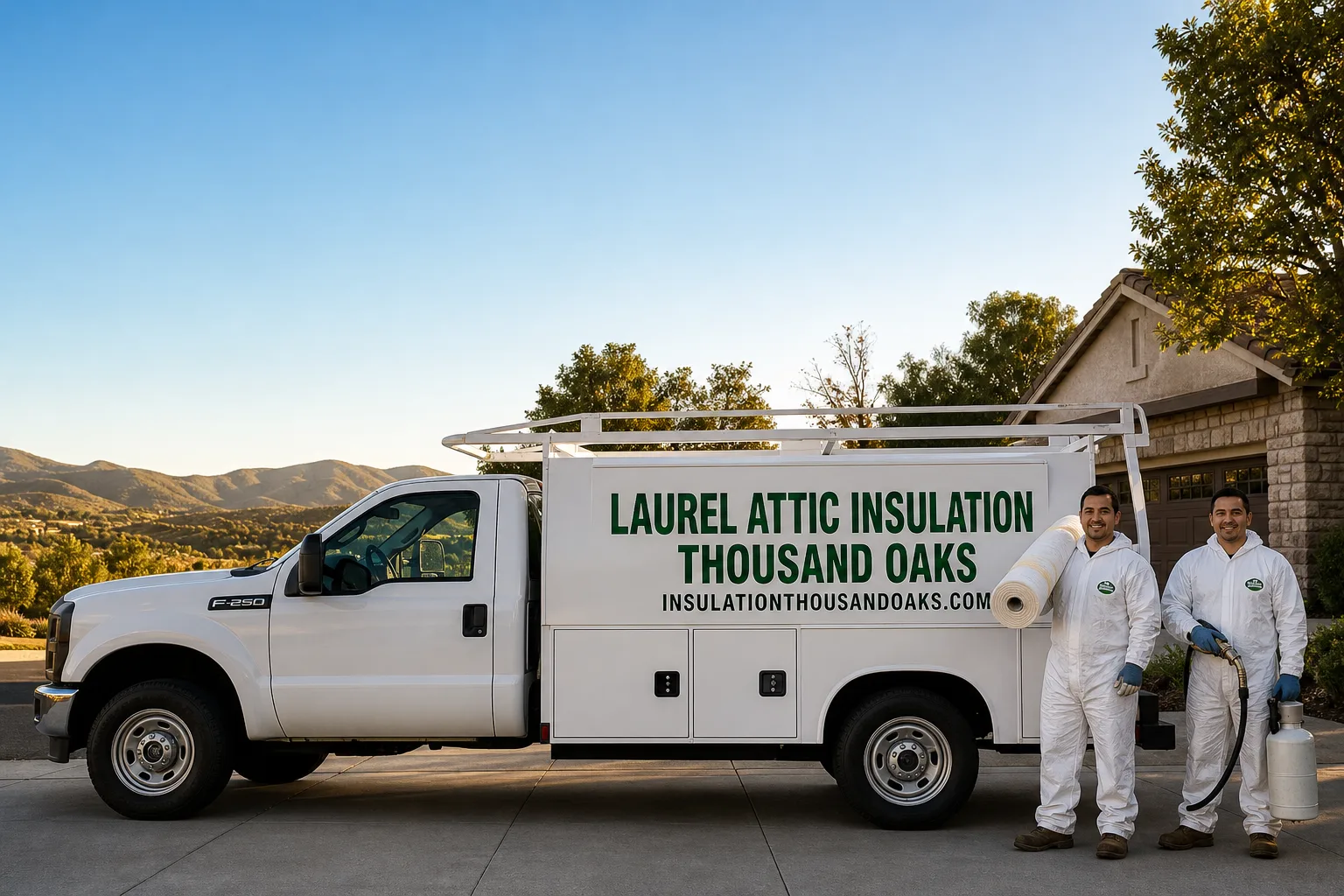
How Much Does Blown-In Insulation Cost in Thousand Oaks?
Blown-in insulation in Thousand Oaks typically costs $1.40 to $3.10 per square foot installed, with most whole-attic jobs for a 1,500 to 2,200 sq ft home landing between $2,100 and $5,800 depending on material type and R-value depth. A smaller job, like topping up the insulation over a two-car garage, often runs $900 to $1,600. Call (820) 200-1971 for a written, line-item quote based on your actual attic measurements, not a ballpark guess.
Blown-In Insulation Cost Breakdown (2026)
The table below shows what Thousand Oaks homeowners paid across 2025 and early 2026 for common blown-in insulation projects. These are real market numbers, not national averages pulled from a database, because Thousand Oaks labor rates and permitting rarely match what national guides show.
| Job Type | Material | Typical Price Range |
|---|---|---|
| Attic top-up (existing insulation, add 6-8 inches) | Fiberglass | $900 – $1,600 |
| Attic top-up (existing insulation, add 6-8 inches) | Cellulose | $1,000 – $1,800 |
| Full attic re-insulation (1,000 – 1,500 sq ft) | Fiberglass | $1,700 – $3,200 |
| Full attic re-insulation (1,000 – 1,500 sq ft) | Cellulose | $1,900 – $3,600 |
| Full attic re-insulation (1,500 – 2,500 sq ft) | Fiberglass or Cellulose | $3,400 – $5,800 |
| Wall cavity dense-pack (per 100 sq ft of wall) | Cellulose | $220 – $380 |
| Attic air sealing + blown-in insulation combo | Fiberglass or Cellulose | $2,600 – $4,900 |
Those numbers include material, labor, equipment setup, and cleanup. They do not include insulation removal, which runs separate at $1.50 to $3.00 per square foot depending on what’s up there and whether vermiculite or rodent contamination is present.
What moves you toward the higher end of those ranges? Three things: the R-value depth you’re after, how much old insulation has to be removed or worked around, and whether your attic has real access issues like a narrow hatch, low slope, or recessed lighting fixtures that need baffling. In neighborhoods like Wildwood or Lynn Ranch, where ranch-style homes often have shallow truss attics, we regularly see higher labor costs simply because the crew works crouched or prone for the whole job. In Newbury Park’s newer builds, taller attics bring that labor number back down.
What Affects Blown-In Insulation Pricing in Thousand Oaks
Six factors move the number on your quote more than anything else. Here they are, ranked by how often they hit Thousand Oaks homes:
- R-value target. R-value is the number that measures how well insulation slows heat from moving through your ceiling. California Title 24 building code requires at least R-38 in attics for new construction, and many Thousand Oaks homeowners upgrading older homes choose R-49 or R-60 to cut their SCE cooling bills during August heat. Each R-value bump adds depth, and depth adds material cost. The jump from R-38 to R-60 typically adds $600 to $1,100 on a 1,800 sq ft attic.
- Square footage of the attic floor. This is the obvious one, but the Thousand Oaks twist is that many 1960s and 1970s homes in the Conejo Valley have unusual attic footprints with multiple gables and bump-outs. Shotgun-math square footage from a real estate listing often runs 8-12% low for attics. We measure from the attic, not the listing.
- Material choice: fiberglass vs. cellulose. Fiberglass runs slightly cheaper per square foot and resists settling. Cellulose (recycled paper treated with borate) is denser, does a better job slowing airflow, and costs 10-15% more installed. In wildfire-adjacent zones, some Thousand Oaks homeowners choose cellulose for its fire resistance. We install both, matched to the job. More on that on our Blown-In Insulation in Thousand Oaks page.
- Existing insulation condition and removal. If your current insulation is water-damaged, full of rodent droppings, or compacted to half its original depth, it needs to come out before we blow in anything new. Removal adds $1,500 to $3,000 on a typical attic and pushes the total project out by half a day.
- Access and obstructions. Recessed lights need baffles so insulation doesn’t sit against the can housing. Bathroom fans need venting checked. Kneewall spaces in split-level homes take extra time. Each of these adds $100 to $250 here and there, and they add up fast if you have ten can lights and three fans.
- Air sealing scope. We recommend air sealing before any blown-in insulation job, because insulation slows heat but doesn’t stop air from leaking around penetrations. Sealing top plates, electrical boxes, and plumbing vents in a typical Thousand Oaks attic costs $500 to $950 and pays for itself in one cooling season.
The short version: if your attic is clean, accessible, and already has some insulation, your quote lands at the low end. If there’s a 40-year-old wildlife situation up there, it goes high. Either way, you’ll see the exact line items on paper before we start anything.
How Much Does Blown-In Insulation Cost Per Square Foot in Thousand Oaks?
The per-square-foot number you’ll see quoted most often is $1.40 to $3.10 for installed blown-in insulation. That range covers both fiberglass and cellulose across typical Thousand Oaks attics.
Here’s the thing about per-square-foot pricing: it’s a math shorthand, not a quote. What you actually pay depends on depth, and depth is the R-value decision. Blowing fiberglass to R-38 in a clean 1,200 sq ft attic might land at $1.60 per square foot. Blowing cellulose to R-60 in a 1,200 sq ft attic with 6 recessed lights, a tight scuttle hole, and some old batt removal to handle could land at $2.80 per square foot.
Both are honest numbers. Neither one is the whole story. A written quote shows each cost category: material by bag count, labor hours, disposal if needed, and air sealing separately. No lump-sum mystery.
Is Blown-In Insulation Worth It for a Thousand Oaks Home?
Short answer: yes, in most cases, and faster than you’d think. The Thousand Oaks climate means mild winters and hot, dry summers. Your attic in July can hit 130°F while your living room thermostat reads 76°. That’s a 50-degree temperature difference forcing your AC to work against a superheated ceiling space.
Blown-in insulation at R-49 or R-60 drops that heat transfer dramatically. We’ve measured attic-to-living-space temperature deltas drop from 20-plus degrees to under 8 degrees in homes we’ve re-insulated near Thousand Oaks Boulevard. That translates to real SCE bill reductions, typically 10-25% depending on how much insulation you had before and how old your HVAC is.
Beyond the energy math, blown-in insulation also:
- Cuts down on dust and pollen intrusion in spring when the Santa Ana winds blow through the Conejo Valley.
- Reduces heat-damage stress on AC units that sit in or near the attic.
- Fills gaps and uneven spots that batts leave behind around trusses and cross-bracing.
- Brings older homes closer to current Title 24 ventilation and energy standards.
You asked about cost, so here’s the honest cost-versus-benefit framing we give every Thousand Oaks homeowner: a $3,500 blown-in insulation job that cuts $60/month off your summer electric bill pays for itself in about four cooling seasons. That’s before you factor in the comfort improvement, which is immediate.
Fiberglass vs. Cellulose Blown-In: Cost Difference in Thousand Oaks
Cellulose runs about $0.20 to $0.35 more per square foot installed than fiberglass. On a 1,500 sq ft attic, that’s a $300 to $525 difference. Not huge. Here’s what separates the two materials in practice:
Fiberglass blown-in is lighter, doesn’t settle much, and holds its R-value over time. It’s made from spun glass fibers and is naturally non-combustible. It’s the more common choice in Thousand Oaks attics where the framing is newer and air sealing has already been done.
Cellulose blown-in is denser, which means it slows airflow better than fiberglass at the same R-value. It’s made from recycled paper treated with borate, which resists both fire and pests. In Thousand Oaks, where wildfire season is a real annual concern, some homeowners in the hillside areas like Sunset Hills and Los Padres-adjacent neighborhoods specifically ask for cellulose for the fire retardant. It settles slightly over the first year, which is why we factor settling into the initial depth calculation.
Both come from brands we stock directly: Owens Corning and Johns Manville for fiberglass, and GreenFiber for cellulose. No mystery bags from a big-box store.
What Is the Cheapest Insulation to Blow Into an Attic?
Fiberglass blown-in is the lowest-cost option per square foot in Thousand Oaks, running about 10-15% less than cellulose for the same R-value. The appeal is real: it’s the material choice that keeps a 1,200 sq ft attic under $3,000 in most cases.
The caveat is that cheap material installed badly is more expensive than good material installed right. The common failure we see is insufficient depth. Some contractors quote a price for R-38 and blow R-30, betting you’ll never get up there with a ruler. Your energy bills find out in August.
Also worth knowing: home energy upgrades sometimes qualify for Southern California Edison rebates or federal tax credits through the Inflation Reduction Act. The rules change, so we don’t promise a rebate number, but we’ll tell you if your project might qualify and point you to the current program details. We don’t file the paperwork for you, and we won’t pad the quote to get one.
Can You Do Blown-In Insulation Yourself? What’s the Real Savings?
You can rent a blowing machine from a hardware store, buy bags of fiberglass or cellulose, and go to work. The materials for a 1,200 sq ft attic at R-38 run about $700 to $1,100 at retail. Machine rental runs another $50 to $100 a day, and you’ll need a second pair of hands to feed the hopper while you handle the hose in the attic.
So the raw savings look like $1,500 to $2,500 versus hiring us. Before you grab a rental, know what you’re signing up for:
- Attic work in Thousand Oaks heat. A July attic runs 110-135°F. You’ll be up there for 3 to 5 hours if it’s your first time. Heat exhaustion is real, and it happens fast.
- Depth consistency. Hitting R-38 evenly across an attic takes practice. Most DIY jobs end up with peaks and valleys, and valleys are where heat sneaks through.
- Air sealing. Most DIYers skip it, which makes the insulation dramatically less effective. Air sealing above wall top plates and around penetrations is the part that actually stops the heat, not just the fluffy stuff.
- Recessed can lights. Insulation touching a non-IC-rated can light housing is a fire hazard. You need to know which cans you have and baffle them correctly, or just don’t insulate around them, which creates a heat leak.
- Ventilation. Blocking soffit vents with blown insulation is the most common DIY mistake, and it turns your attic into a moisture trap, but worse, it can void your roof decking warranty and lead to mold. Baffles are required in most Thousand Oaks homes unless the roof is unvented by design.
We’ve seen enough DIY blow-ins get redone within two years that we’re confident in this recommendation: the savings aren’t worth the sweat, the safety risk, or the likely redo. If you want the job done once, with photo proof of depth consistency and written documentation of the R-value achieved, call (820) 200-1971 and get a real quote. You might find the gap between your DIY materials cost and our installed price is smaller than you think.
How to Save on Blown-In Insulation in Thousand Oaks
You don’t need to cut material quality to bring the cost down. Here are the levers that actually move the number on a quote, without leaving you with a code-violating or ineffective install:
- Do a top-up instead of a full removal. If your existing insulation is dry, clean, and at least somewhat present, we can blow over it. Topping up from R-19 to R-49 costs less than half of a full removal and reinstall. This is the single biggest savings lever for most Thousand Oaks homes built before 1990.
- Time it in the off-season. Insulation is seasonal work, and the peak demand hits in late spring and early summer when the first heat wave reminds everyone their attic is an oven. Scheduling in January or February in Thousand Oaks can save you 5-10% on labor, and we run off-season specials most years.
- Bundle it with air sealing. It sounds counterintuitive to recommend adding a line item, but doing air sealing at the same time as the insulation is cheaper than doing it as a separate visit. You’re already paying for the setup and attic access, and the sealing work takes a crew a few extra hours.
- Ask about the exact R-value you need. R-49 is a good target for most Thousand Oaks attics. R-60 gains you maybe 3-5% more thermal performance for a noticeable cost bump. If you’re on a comfortable budget, R-60 is fine; if you’re watching costs, R-49 does the heavy lifting.
- Check for utility rebates before you commit. Southern California Edison and the SoCalGas territory sometimes offer insulation rebates. Program details shift, and we stay current on what’s active. Mention it when you call and we’ll check what’s available for your address.
One thing we’ll say plainly: free is the best price. Our estimates are free, in writing, and line-itemed. You’ll get the full quote before you agree to anything. Call (820) 200-1971 and we’ll measure the attic, talk through your options, and hand you a written number. No obligation and no follow-up phone campaign.
FAQs – Blown-In Insulation Cost in Thousand Oaks
How much does blown-in insulation cost in Thousand Oaks?
Most blown-in insulation projects in Thousand Oaks run $2,100 to $5,800 for a full attic, or $900 to $1,600 for a top-up. The exact number depends on your attic’s square footage, R-value target, and whether old insulation needs removal. Call (820) 200-1971 for a written quote based on your measurements, not a guess.
Is it cheaper to repair or replace attic insulation?
If your existing insulation is dry, clean, and at least halfway to the R-value you want, topping up is always cheaper than removing and replacing, typically $900 to $1,600 versus $2,500 or more. In Thousand Oaks, where many homes have 30-year-old R-19 batts, a top-up to R-49 is the most cost-effective option for about 60% of the attics we see.
How long does blown-in insulation last?
Good blown-in fiberglass lasts 30 to 50 years with no meaningful R-value loss. Cellulose settles in the first year and then holds steady for 20 to 30 years. What shortens the lifespan in Thousand Oaks is moisture from roof leaks, rodent damage, or air sealing issues; we inspect for all three during the estimate.
Can you do blown-in insulation the same day?
In most cases, yes. A typical Thousand Oaks attic takes 3 to 6 hours on site for a full blow-in, including setup and cleanup. Top-ups run faster, often 2 to 4 hours. Call (820) 200-1971 in the morning and there’s a good chance we can get a crew to you the same day or next morning.
Does blown-in insulation qualify for a tax credit?
As of 2026, insulation improvements can qualify for a federal tax credit under the Inflation Reduction Act, though the exact percentage and cap have shifted with recent legislative updates. We’ll tell you what we know when you call, but we won’t pad a quote to chase a credit. Your tax preparer makes the final call.
How much does insulation removal cost in Thousand Oaks?
Insulation removal runs $1,500 to $3,500 for a typical 1,200 to 2,000 sq ft Thousand Oaks attic, depending on material type, contamination, and access. Rodent-contaminated or water-damaged insulation costs more because of the extra handling and sanitation steps required. We’ll give you a separate line item for removal if your attic needs it; we don’t fold it into the insulation price.
Get a Written Blown-In Insulation Estimate in Thousand Oaks
Here’s how it works with Laurel Attic Insulation Thousand Oaks: you call (820) 200-1971, a live person answers, and we schedule a time to measure your attic. You get a written, line-item price before any work starts. No door-step surprises, no vague four-hour arrival windows. The Relay Visibility Guarantee means you’ll see a live arrival time on your phone, get before-and-after photos of the job, and pay from a link when the work is done.
Every job comes with our 365-Day Done Right Promise in writing: if the insulation isn’t done right in the first year, we make it right. And if the repair fails, the second visit is free. No charge, no argument.
Chase Whitaker leads our Thousand Oaks crew. He’s been in attics all over the Conejo Valley, and he’ll be straight with you about what you actually need versus what you don’t. If your attic only needs a top-up, that’s what he’ll quote. If it needs removal and air sealing, you’ll know why and exactly what it costs.
Laurel stays green all year, and so should your home’s comfort. That’s the idea behind the name. Call (820) 200-1971 today for a free, written blown-in insulation estimate in Thousand Oaks.
Pricing reflects the Thousand Oaks market as of 2026. Laurel Attic Insulation Thousand Oaks offers free estimates – call (820) 200-1971.
Written by Chase Whitaker, Owner at Laurel Attic Insulation Thousand Oaks, serving Thousand Oaks and the Conejo Valley since 2003.
What Our Customers Say
"Air sealing around the hatch and can lights. Tidy and quick."
- Mack R."Removed old insulation and replaced it. Upstairs is cooler now."
- Ella F."Quote in the app was clear on R-value and price."
- Doris L.